IDEWE survey: Heatwave? 143,131 employees experience heat stress all year round
When thinking about 'working in the heat' today, people immediately think of roofers and other outdoor professions. And although their work, now that our country is once again bathed in a heatwave, is currently no walk in the park, we rarely stop to consider that in Belgium many people - 143,131 to be precise - deal with heat at work every workday, all year round. This emerges from new figures from IDEWE, Belgium's largest external occupational health and safety service, based on a methodology from the Netherlands Organisation for Applied Scientific Research TNO and KU Leuven in the context of the European Climate Research project Intercambio.
- Unlike outdoor professions such as roofers, they are exposed to heat that is wholly or partially produced by humans.
- Chefs experience the most heat stress with an average of over 4 hours per day, followed by metalworkers and glass/ceramic workers.
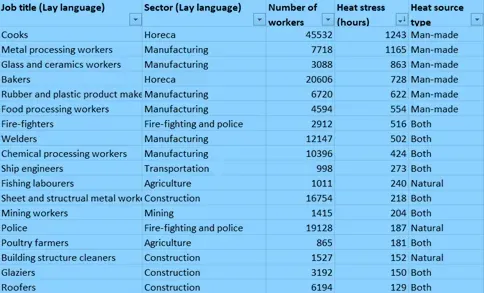
Chefs deal with heat stress by far the most (heat stress is the total heat load to which an employee is exposed through the combination of environmental factors, physical exertion and worn clothing). Annually they are exposed to heat for an average of 1,243 hours - that's over 4 hours per working day. This is followed by metalworkers with an average of 1,165 hours per year, glass and ceramic workers with 863 hours, bakers with 728 hours, rubber & plastic processors with 622 hours and food processors with 554 hours. Notable: the heat in which these 88,258 people work in total is human-produced.
"When thinking of heat professions, we often think of people who work outside in the summer in unsheltered places, such as roofers. Certainly not to be underestimated, but much less known is that so many people spend several hours a day in the heat all year round. In our view, this also deserves attention."
All year round
In total, 164,797 people in Belgium perform heat stress professions. For 143,131 of them, this is due to heat of 'human' or 'human + natural' origin, which therefore plays out at least partially all year round. For only 21,666 people, it concerns exclusively natural, and therefore seasonal, heat.
"Both forms are demanding in their own way, and we certainly must not underestimate them. Heat stress results in an increase in heat storage in the body and can lead to complaints such as fatigue and concentration and productivity loss, and with prolonged exposure even to kidney, heart or respiratory disorders, and mental complaints. And although you obviously cannot completely eliminate the heat, fortunately there are many things you can do as both employer and employee to limit its impact", Lode concludes.
Below are 5 concrete tips from IDEWE to minimize #heat stress:
- Ensure indoor workplaces have ventilation and air conditioning, and install sun shading to limit direct solar radiation. Create shade spots where possible at outdoor workplaces.
- Adjust work and rest schedules, for example by scheduling physically or mentally demanding tasks during cooler moments and taking sufficient breaks (in the shade during hot moments). Also implement flexible working hours if possible.
- As an employer, make access to drinks as accessible as possible by providing chilled beverages in visible and easily accessible locations. Introduce fixed drink breaks when necessary.
- Ensure appropriate clothing that ventilates sufficiently and also protects against sunlight when necessary - nowadays technical clothing is available that is also UV-resistant. Working bare-chested is not necessarily more cooling and increases the risk of burns and skin problems.
- Timely intervention, both for yourself and for colleagues, when the heat becomes unbearable, is very important. Therefore, train employees and supervisors to recognize specific signals - dizziness, excessive sweating, headache, ... - and encourage your teams to report them immediately.