Establishing a social-medical team
Does your organisation aim to pay attention to your employees’ wellbeing? In that case, you need to set up a social-medical team, or SMT. This is particularly important considering that Belgium’s absenteeism rate is approximately 8% (eight out of every 100 working days) and the average absenteeism per employee is 20 days (Acerta, 2023). Each day of absence costs an employer EUR 1,500 in direct and indirect costs. Ignoring absenteeism is no longer an option. A social-medical team has an important role to play in this regard.
What is a social-medical team (SMT)?
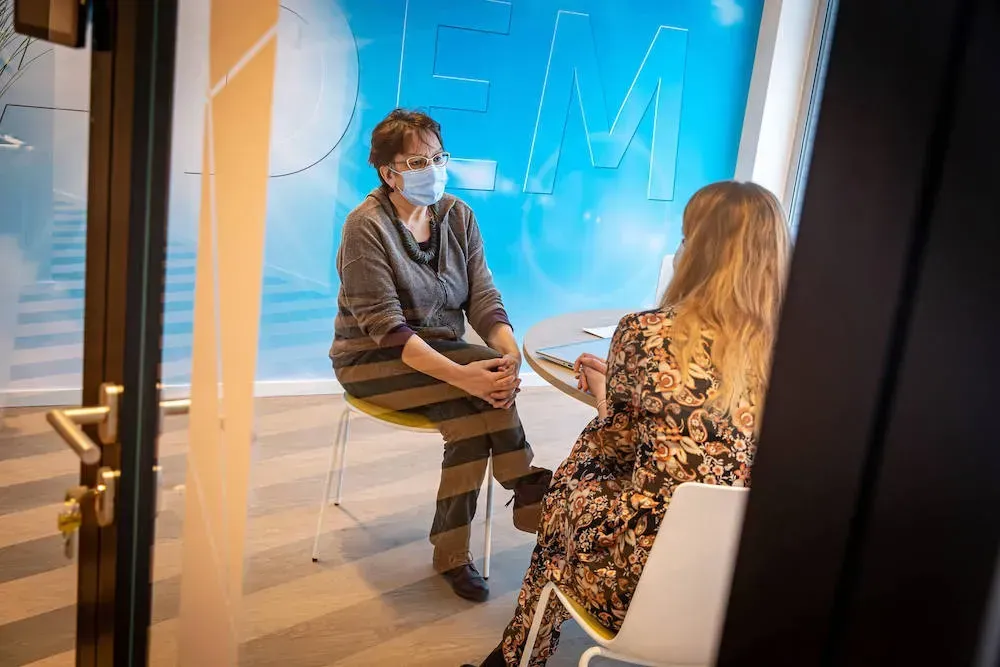
A social-medical team, or SMT for short, is a periodic, interdisciplinary consultation between everyone involved in sickness absence and reintegration. The employer, occupational doctor, prevention advisors and HR department come together to address both individual and structural challenges.
An SMT is particularly interesting for organisations that want to establish a sustainable attendance policy. It facilitates open dialogue between employees who are unfit for work for a long period, the employer and relevant experts. It also makes it easier to detect and address collective health risks and psychosocial burdens promptly. In this way, it contributes to the systematic embedding of reintegration and wellbeing in your organisation.
What are the advantages of a social-medical team?
The sooner you start the reintegration of employees on long-term sick leave, the greater the chance of success. An SMT makes that possible by detecting early signs of long-term absence and immediately implementing supportive measures. This maintains your connection with the employee, even before the initiation of a formal reintegration process.
Furthermore, an SMT supports your organisation at the policy level. With regular consultation, you can discuss and address structural issues such as high work pressure or psychosocial burdens in a specific department. This makes an SMT a powerful tool for the improvement of sustainable employability.
Who should be on a social-medical team?
The composition of an SMT depends on your organisation’s needs. A basic SMT usually consists of someone from HR and the occupational doctor, and focuses on individual cases. A more extensive SMT will include prevention advisors , managers and, possibly, confidential counsellors or specialists in psychosocial aspects and ergonomics.
Depending on the situation, an employee may be invited to join in as well. This enables a multidisciplinary approach with a combination of perspectives and ensures support for decisions.
How do you set up an SMT?
You set up an SMT once your organisation has already started working on a sustainable attendance policy. This often happens at the internal prevention service’s initiative or on IDEWE’s recommendation.
It is important to draw up a set of house rules beforehand in order to define the SMT’s operations and ensure confidentiality. The rules must include a privacy clause and be approved by the Committee for Prevention and Protection at Work (CPBW). This ensures that all participants will handle personal data with care. Additionally, employees must explicitly consent to discussion of their files.
Ideally, an SMT meets four or five times a year. A coordinator invites participants, leads the meetings and ensures reporting and follow-up.
How IDEWE will support your social-medical team
IDEWE can guide organisations through every step of getting their SMT set up and operational. Our experts can assist you with:
- Adapting your SMT to fit your attendance and reintegration policies
- Determining the appropriate team composition
- Drawing up house rules and a privacy clause
- Training the people involved on managing sickness absence efficiently and with respect