Prevent stress and burnout among your employees with a strong prevention policy
A healthy working environment makes employees feel happier, which in turn improves performance. That’s why a strong prevention policy is key in preventing long-term stress and burnout among your team. We’ll be happy to help with training and advice.
Find out how to prevent long-term stress and burnout and improve resilience in the workplace.
On this page:
What is the difference between stress and burnout?
Stress is a natural response to pressure and challenges. You need a certain amount of stress to be able to function properly, such as when you need to give a presentation. However, if the stress becomes chronic, we talk of unhealthy stress – and this can lead to burnout.
Burnout is a state of emotional, mental and physical exhaustion. You feel burnt out, and can’t find the energy or motivation to get things done.
What are the first signs of burnout?
- Tiredness that doesn’t go away, even after a period of rest
- Problems remembering things and lower concentration
- Being irritable and emotional exhaustion
- Reduced motivation and work performance
- Physical complaints such as headaches and achy muscles
Want to tackle stress and burnout in your organisation? Ask our experts for advice
What are the causes of burnout?
Burnout can happen to anyone. However, you may be more susceptible to it if you’re a perfectionist or like to keep everyone happy.
Work conditions that increase the risk of burnout:
- High work pressure and unrealistic expectations
- A lack of autonomy and limited control over your work
- Little social support from colleagues or managers
- Uneven work-life balance
- No recognition or appreciation
Less stress means more energy. Create a healthy working environment
Use our awareness-raising materials about wellbeing and stress at work.
You can find everything you need in your My IDEWE Professional customer area.
How can you prevent stress and burnout in your organisation?
As an employer, you play a crucial role in your employees’ wellbeing. You should therefore offer your team a healthy, inspiring working environment.
- Manage the work pressure and set realistic goals and tasks.
- Give employees autonomy and confidence, and offer flexibility both in terms of tasks and working hours.
- Encourage an open feedback culture and help to open up discussions about mental health.
- Pay attention to your employees’ wellbeing and invest in ergonomics, breaks and relaxation.
- Support employees and offer them coaching, wellbeing initiatives and tools such as the Burnout Assessment Tool questionnaire. They can use this tool to assess their stress level and risk of burnout. Employees will receive personalised feedback straight after completing the questionnaire.
How to help your employees cope with stress
Offer your employees support that is easily affordable and appropriate with the Employee Assistance Programme. This programme provides employees with support in their mental, emotional and physical wellbeing for both work-related and personal issues, such as stress, resilience, financial problems, personal development, mild depression or relationship issues.
You could also work with our Fit4Work experts to ensure employees are happier, more resistant to stress and approach life with greater energy.
How do you develop a policy to tackle stress and burnout?
A prevention policy is essential in keeping your employees motivated at work. What’s more, as an employer, you are also legally obliged to identify psychosocial risks and take appropriate measures. You should take the following steps:
- Carry out a risk assessment.
- Appoint a confidential counsellor or prevention advisor on psychosocial aspects.
- Draw up a prevention policy on stress and burnout.
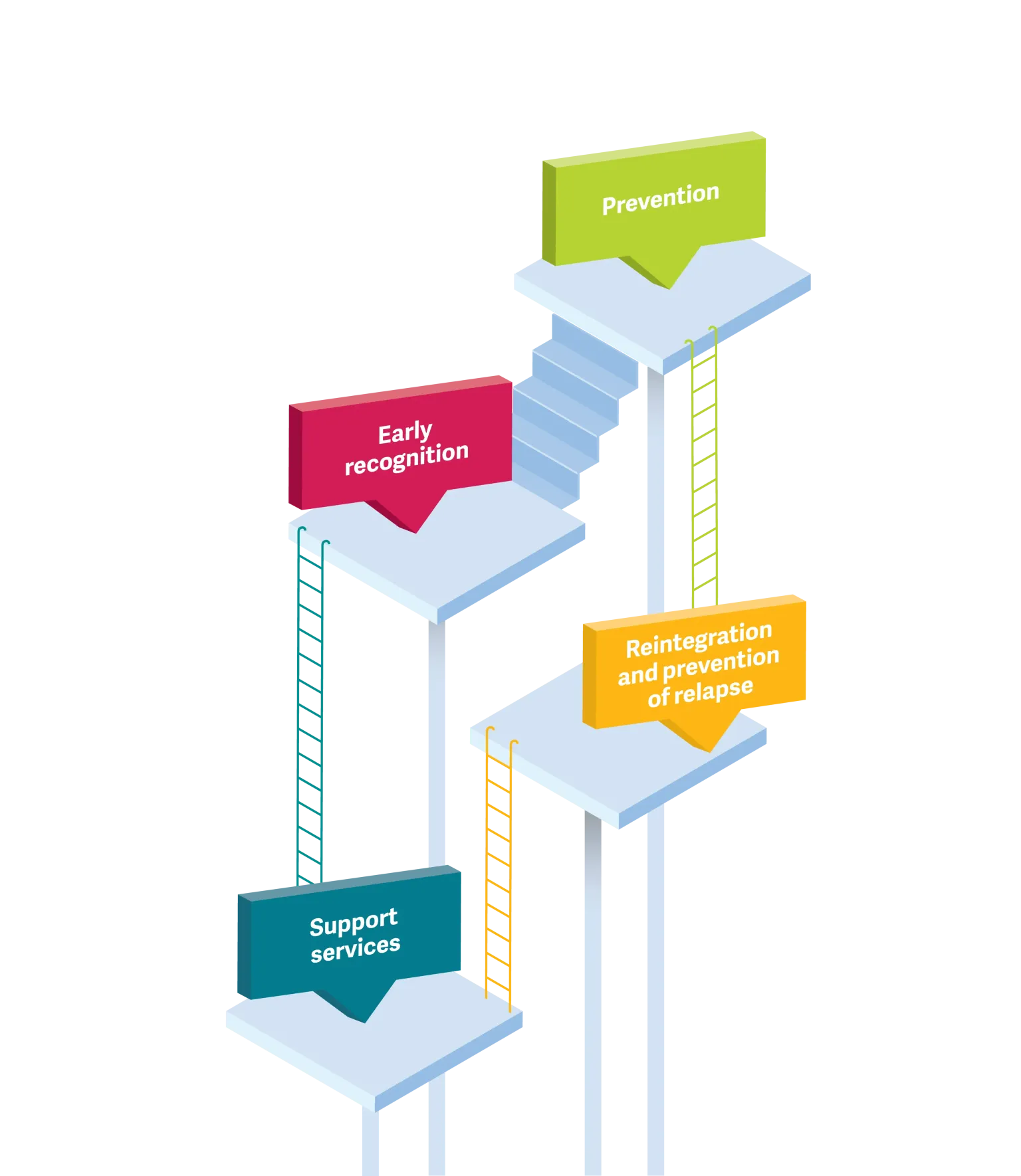
An effective prevention policy consists of four crucial components:
- Prevent stress and burnout – Prevention is the focus of your approach and starts with a well-thought-out vision. To enable you to lay a good foundation, it is best to take a close look at your current HR policy.
- Does your organisation pay attention to wellbeing in case of acute or chronic stress?
- Do you already carry out a psychosocial wellbeing risk assessment?
- Do you pay sufficient attention to the role of managers (as key figures in detecting initial signs of stress among your employees) and engage in dialogue where necessary?
- Recognise signs of stress – Take action before it is too late. How do you become aware of early symptoms of stress and burnout? Raise awareness among HR staff, managers and employees through training courses and workshops.
- Offer support pathways – Do you have employees who are struggling with too high a workload? Offer them short-term support with our reload pathway for employees.
- Guide employees through reintegration – Ensure your managers and teams are well-prepared to welcome back long-term absentees on their return to work. This helps you to prevent employees relapsing and ensures an optimal reintegration. Our prevention advisors support employees, managers and teams with our reconnect pathway.
Ready to work on a long-term approach to stress and burnout?
Talk to our experts to find out which support best suits your organisation.
Why choose IDEWE?
- Experienced experts – Our experienced prevention advisors on psychosocial aspects make sure you receive the right support.
- Discretion – Your company and personal data, including that of your employees, is handled with the utmost care.
- Preventive approach – We believe that prevention is better than cure. IDEWE offers proactive support to prevent absences.
D-STRESS research project
Did you know the D-STRESS research project is using a combination of technology and AI-based monitoring with blended coaching to assess employees’ stress levels and recovery?
An mHealth app gives employees insight into their own stress data and personalised advice, while coaches (such as occupational doctors) can intervene promptly with tailored interventions.
This will enable employers to take a science-based approach to managing mental health preventively, preventing burnout and reducing absenteeism. D-STRESS is a collaboration between IDEWE, KU Leuven, Mind Body Research, Faresa and Cegeka, running from 1 January 2025 to 31 December 2026.