What is the cost of an external service for prevention and protection at work (ESPPW)?
Are you looking to affiliate yourself with an external service for prevention and protection at work? Of course you also want to know how much it will cost. The cost depends on various factors such as how many employees you have, the risks specific to your sector and the applicable formula for your organisation.
Use our simulator to calculate your contribution
On this page:
- Is an affiliation with an external service (ESPPW) mandatory?
- How are the rates charged by an external service (ESPPW) determined?
- What are the costs per employee?
- What do you get in return?
- What is included in a basic package?
- How does the formula with prevention units work?
- How does an external service benefit your organisation?
Is affiliation with an external service (ESPPW) mandatory?
Yes. In practice, affiliation with an external service for prevention and protection at work is mandatory for nearly every organisation with one or more employees in Belgium.
According to welfare legislation, all employers are required to have an internal service for prevention and protection at work and to appoint an internal prevention advisor. This internal service is responsible for ensuring the wellbeing and safety of employees.
To be able to handle all the associated legal duties themselves, organisations must have expertise in areas such as occupational safety, health, ergonomics, occupational hygiene and psychosocial aspects. Health monitoring must also be carried out by an occupational doctor.
For many organisations, it is not feasible to have all that expertise available internally. That is why, in most cases, employers are legally required to affiliate themselves with an external service for prevention and protection at work.
When are you considered an employer?
Do you have at least one employee? In that case, you are legally considered an employer and affiliation with an external service is mandatory for you. This also applies if you are employing anyone temporarily, such as temporary workers or student workers. Interns and trainees are included as well, even if they are unpaid.
How are the rates charged by an external service (ESPPW) determined?
It is legally defined how much an external service for prevention and protection at work may charge for its services. This makes it easy to calculate the cost of an external service for every employer.
Your rates depend on:
- Your company’s main activity according to your NACE code
- The rate group for your organisation
- The estimated number of employees
- Your internal prevention advisor’s certification level
- The applicable formula for your organisation; basic package or prevention units
Your main activity determines the statutory rate group for your company. The size of your organisation also matters. This is determined based on how many employees you had on 30 November of the previous year.
What are the costs per employee?
You pay one flat-rate contribution per employee, regardless of whether or not an employee is subject to health monitoring. The law determines the applicable minimum rate for your company.
That rate depends on your company’s main activity. This is determined by your company’s NACE code. On this basis, you fall under one of five statutory rate groups.
Some examples:
- Rate group 1: Banks, insurers, travel agencies, primary and secondary education
- Rate group 2: Architects, associations, recreation, higher education
- Rate group 3: Trade, rentals, leasing, non-municipal public authorities
- Rate group 4: Manufacturing, industry, transport, cleaning, municipalities
- Rate group 5: Chemicals, construction, healthcare, police and fire services
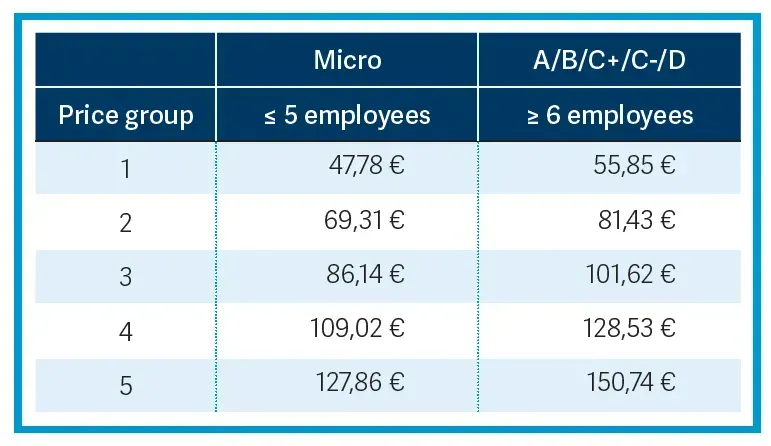
Did you have five employees or fewer on 30 November of the previous year? In that case, you qualify for a reduced micro-rate per employee.
Note that a fixed travel charge applies for on-site services.
What do you get in return?
The cost of an external prevention and protection service covers much more than just occupational health examinations. You are also investing in support regarding safety, health and employee wellbeing.
The exact services you receive depend on:
- The number of employees at your company
- Your internal prevention advisor’s certification level
- The system applicable to your organisation
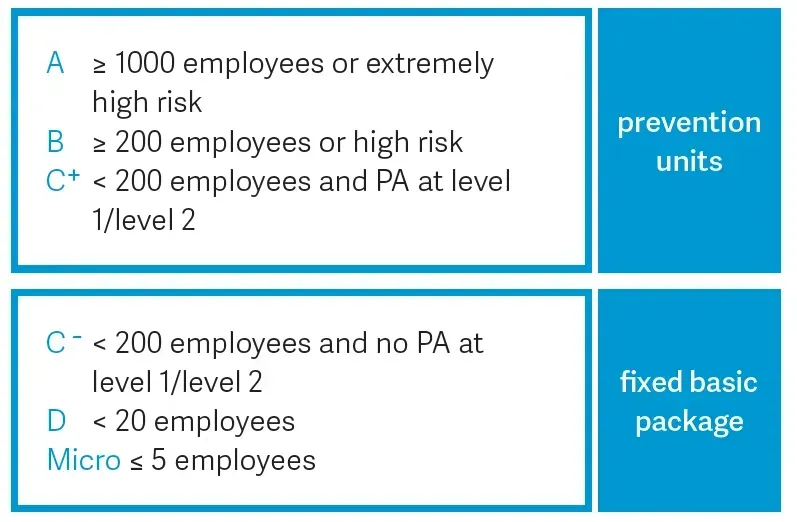
There are two systems:
- A fixed basic package
- A formula with prevention units (PU)
The basic package is usually applicable to smaller organisations. Larger companies are more likely to make use of prevention units, providing more flexible access to wellbeing services.
See below on this page for an explanation of exactly how the two systems work.
Which system is applicable to your organisation?
Not all organisations fall under the same rate system. Your organisation will be considered part of a certain business group depending on your rate group, how many employees you have and your internal prevention advisor’s certification level.
Prevention units are used for all organisations in business groups A and B (200+ or 1000+ employees, respectively, or higher risk). Organisations in rate group C with fewer than 200 employees also receive prevention units if they have an internal prevention advisor with at least Level 1 or Level 2 certification.
The fixed basic package applies to:
- Organisations in group C with fewer than 200 employees without a Level 1 or Level 2 internal prevention advisor
- Organisations in group D with fewer than 20 employees
- Organisations eligible for the microrate (five employees or fewer)
Are you unsure which system applies for your organisation? Our experts will be happy to help you.
What is included in the basic Comfort formula package?
Is the fixed basic package applicable to your company? Your flat-rate contribution pays for a variety of statutory prevention and wellbeing services.
The basic package includes:
- Support with risk assessments
- Proposals for preventive measures
- All mandatory medical examinations
- Examination of workplaces and workstations
- Psychosocial interventions
- Policy advice on prevention and wellbeing
- Support with display screen equipment
- Participation in CPPW meetings
- Investigation of serious accidents at work
- Online access to delivered services and reports
This flat-rate system also includes access to any health records and food hygiene support relevant to your organisation.
As an employer, you receive support with your entire prevention policy and are in compliance with your legal obligations regarding employee wellbeing.
Note that a fixed travel charge applies for on-site services.
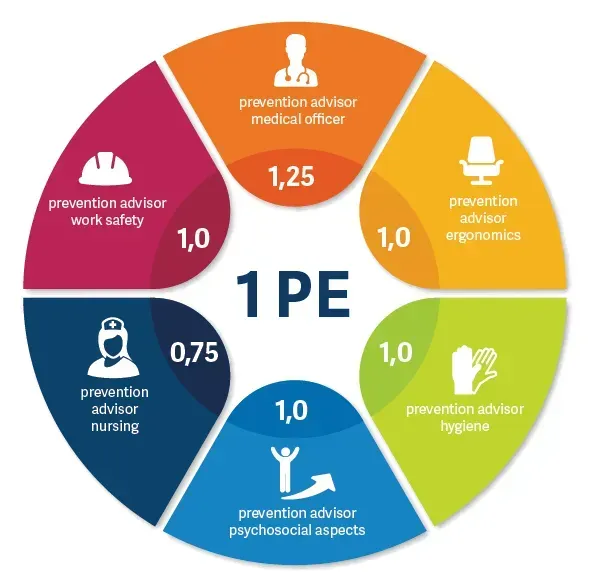
Priority uses of prevention units:
- Health monitoring and medical examinations
- Psychosocial support
- Access to health records
The cost of a service depends on the type of prevention advisor involved. The following statutory weighting factors apply:
- Occupational doctor
- Prevention advisor for occupational safety
- Prevention advisor on psychosocial aspects
- Occupational health and safety officer
- Ergonomics expert
- Nursing expert
What if you have used all your prevention units?
Have you used all your prevention units? In that case, additional services will be charged separately at the statutory rate of €154.78/hour, multiplied by the applicable weighting factors. Do you still have prevention units left at the end of the year? Use them to provide even more support for health, safety and employee wellbeing.
You can easily check your prevention unit status in your My IDEWE Professional customer area.
Need advice on the use of your prevention units? Our experts will get you started.
How does an external service benefit your organisation?
An external service doesn’t just help ensure legal compliance. You are investing in healthier employees, fewer absences and a stronger wellbeing policy. That investment has clear returns: lower risk, more resilience and an organisation that is stronger over the long term.
At IDEWE, we also consider this added value from the perspective of your return on prevention: what are the concrete benefits of investing in wellbeing for your organisation? Figures on psychosocial wellbeing and ergonomics show that prevention not only pays off for people, but can also offer financial benefits.
You can also see this impact in practice. VitaS worked with IDEWE to develop a low-threshold wellbeing programme that gets employees moving both physically and mentally. At Evara, the Employee Assistance Program soon found acceptance and absenteeism was seen to drop. And at WZC Sint-Elisabeth Duffel, the ergonomics radar grew into a practical tool for more effective prevention of back problems and sustainable embedding of ergonomics in the workplace.
Looking for a partner for prevention, health and employee wellbeing?
*All prices quoted are subject to change or adjustment in response to government decisions and publications.